Scale Model Challenge 2017

I’m back from SMC with lots of pictures, and I’m sure they’re more interesting than anything I have to say to most of you, so here they are. Apologies for the quality, but the lighting was exceptionally harsh, so a lot of pics are quite washed out. You’ll just have to go to a show to see them yourselves.

I’ve also singled a few out for extra attention, and they get especially large pics. You can see them full size if you open out the thumbnails. First up, what I think are pretty obvious choices for extra attention: the best in shows that I remembered to get pictures of:

The really obvious piece by Chris Clayton, an amazing diorama (I believe it won one of the Best of Show prizes at Monte San Savino last year) and a frankly ridiculous boat:

And finally some pieces by Marijn van Gils that were on display. I think a lot of people probably didn’t notice them, but they’re some of the best works I’ve ever seen and still stand up today. I first saw them at the World Expo in Montreux, and I believe they were a few years old even then. The statue piece may well be the best piece I’ve ever seen (no offence to the people above, of course).

And now I get to my usual waffle and some thoughts on the show.

First off, SMC is one of the best shows I’ve ever been to. While it wasn’t quite up there with the World Expo in Stresa, that’s a difficult bar to reach because of the location in sunny northern Italy (a place I’d actually wanted to go to for a couple of decades), the sheer size and the fact that I got engaged there – which all makes it a very difficult act to follow.

Regardless, the show was brilliant. Always lots to do and to see, a really excellent range of traders, and, of course, the quality of the entries, which you can see is top notch. The only issue I really have with it is that it’s sort of in the middle of nowhere. I always feel that multi-day shows should be somewhere that you can leave – wander off to have drinks in a cafe with other painters, look at a castle or wander around gardens. That sort of thing. This isn’t the sort of show I’d bring my wife to – she enjoys the hobby and supports me going to these places, but she’d get bored pretty quickly and wouldn’t really enjoy being stuck at a convention centre 30 minutes’ bus-ride from town.

I’ll be back next year, and I’ll try to get a room in the convention centre itself or in Veldhoven. Our hotel in Eindhoven was ridiculously good, but no one else was around and we had to be constantly aware of the bus timetable.

The judging at the show was quite an eye-opener, too, as it set a considerably higher bar than other competitions I’ve been to. Most shows I usually expect 50% or more to get highly commended or a medal. It sounds generous, but these shows are self-selecting: people who aren’t really interested in getting to the next level in quality don’t usually attend, so 50% is usually still a reasonable standard. SMC, meanwhile, gave out 18% medals, and I guess maybe the same again in highly commended.

While I did get highly commended in historical masters for my Murmillo gladiator, I’m not too bummed about missing out in fantasy masters – there was a lot of stuff that was a lot better than mine that also got nothing, and I would’ve felt like the judges had cocked up if I did get something.

At the end of the day, I’m not terribly competitive anyway. I use shows as a way of benchmarking where I am in the hobby (which increasingly feels like a process of playing catch-up – seriously, look at the stuff above) and seeing where it is I can improve, what other people are doing to push boundaries, and so on. For me, that’s pretty much the best part of shows – that, and meeting up with painting friends for beers. And shopping.

With that, I’ll be back to talking about my own painting for the next few months. Next show will likely be Duke of Bavaria in April next year.

Big cats and little Romans

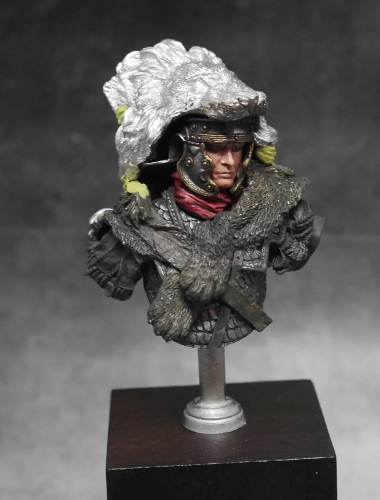
Only a brief update this week as I’ve only really worked on the signifer and don’t have a long rambling bit of discussion to go with it. Viz:

As you can see, I’ve mostly finished the Roman and started on the lion pelt, which is surprisingly enjoyable. I don’t generally enjoy painting fur textures, but there’s enough interest in this one, with nice shapes and extra colours that it’s actually reasonably fun. We’ll see if the mane is as enjoyable. Looking at the pictures, I need to strengthen the shading on the paws, but otherwise it’s coming along nicely.

Next week, I’ll be attending Scale Model Challenge, so expect a longer, more thoroughly illustrated update when I return.

Romanes eunt domus

The cyborg veteran is now complete, with pics over on Putty and Paint. I’m really happy with how he came out in the end. The predicted fix on the skull, touching up the reflection spots on the greenish NMM-ish parts and a marking did what I wanted them to. He’ll be heading over to Scale Model Challenge at the end of next week, so if you’re heading there yourself, you might be able to find him to check him out.

What you might notice is that I didn’t go with a squad marking or designation in the end; instead, I went with the Weyland-Yutani logo. For those somehow not in the know, the Weyland-Yutani Corporation is the company behind all of the nefarious plots in the Alien films. It’s obviously pretty well known among sci-fi fans, which lets me provide some narrative to the piece without actually doing a whole lot myself.

This is a technique that’s been used in literature and the visual arts for centuries, and especially with the rise of cubism and later modernist movements. In cubism, in particular, it took on a pretty interesting position. If you remember your art history, you might recall that the cubists moved into collage and montage in the later stages, which is where they really developed what they called ‘ready-mades’. This is where you take something that is known and place it into a new context; it brings with it all of the meaning and connotation it had in its original context and lays this over its new context. It can be pretty interesting, and it can be quite confrontational. Probably the most famous use of a ready-made is Marcel Duchamp’s ‘Fountain’, which is just a urinal turned upside-down.

Obviously, that’s an extreme example of a ready-made, and you can just use something simpler or less… absurd. In painting miniatures, things like this can be really useful, and we often do them without really thinking about it – you might use a sign pointing the way to Raccoon City, for instance, or a poster advertising the new wonder drug Ubik, and so on. You’re attempting to bring an already fully formed idea into your work. You can even do it just with the name of a piece. One of my more recent pieces, for instance, I call Lemarchand Configuration no. IV. To most people, I imagine, that’s just kind of an odd name that suggests something, but you’re not sure what. To a fan of the Hellraiser universe, however, it’s much more significant – it’s one of the Lament Configurations that opens portals to other… realms, so the whole piece takes on (I hope) a new meaning.

Anyway, that’s just a bit of insight into one of the many ways I try to bring narrative into my works.

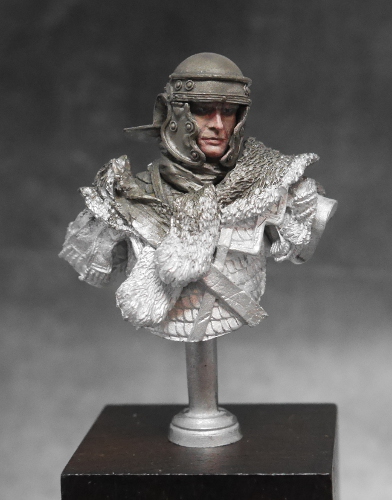
In other news, I’ve been working on the Roman Signifer again. I’ve repainted his face, painted all the other stuff around it, and assembled him. By god, he’s a weighty chunk of metal.

P1030295

I’m really happy with the face having been reworked (although I still had to paint around the cheek guards – it turns out my superglue was just a little too good, and removing them to get at the rest of the face would likely have caused irreparable damage), and all the rest is working out pretty well. However, all is not plain sailing.

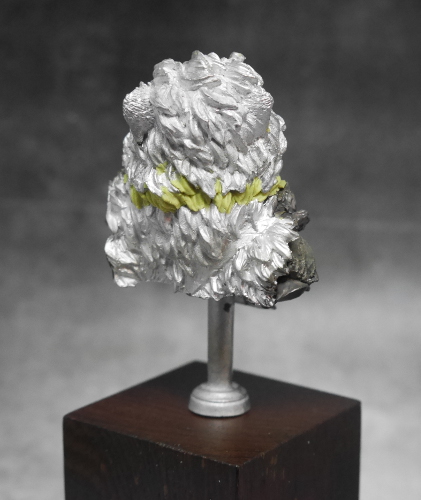
I have no idea how it happened, but somehow the head of the lion does not fit. Perhaps I managed to get the legionnaire’s head at just slightly the wrong angle, or I was meant to grind something down. It probably isn’t the cast or the sculpt – Pegaso pieces usually fit together excellently. Regardless, the join lines up beautifully on one side if you want the lion to be looking over to the legionnaire’s left (hard to the left, that is, like some sort of first century rapper who wears his lion’s head at a jaunty angle because he’s totally Via Appia), but does not line up at all if you want it looking straight ahead as it is in the box art. In the end, I was forced to sculpt to fill some pretty huge gaps. As you know, I detest sculpting.

P1030296

This move from painting sci-fi to historical brings me neatly to my next point, which is something I’ve been thinking about since Euro.

“What do you do?”

At the competition, I met a whole tonne of new people, and it seemed that all of them wanted to ask this question. Normally, I’d say “I’m a technical writer, and it’s not very interesting”, but it was quite clear that they wanted to know what sort of things I painted. It’s a weird way to ask it, but whatever. What I feel many of them really wanted to know was where I fitted into the hobby: was I some sort of degenerate who only paints Napoleonics? One of those weird sci-fi nerds with no appreciation for history? Perhaps a closet neo-Nazi who paints US Civil War Confederates but really wants to paint Schutzstaffel?

I’m reasonably sure my generally confused looks and mumbling about painting whatever grabs me got the point across that I’m not particularly allied with one topic or era, but I think it’s an interesting topic to discuss.

We all pick the models we paint for a reason. I’m not going to begrudge someone for only painting Napoleonics, for instance – I may not really understand why you’d limit yourself, but I can appreciate that for some people there’s a real fascination with that part of history (and the uniforms are really something else). Equally, I don’t think someone who confines themselves to fantasy or sci-fi is doing the hobby a disservice: I’ve heard as many people talk about the incredible creativity of that part of the hobby as I have people muttering that the real world has all the horror and significance you could possibly want.

For me, I sort of muddle around until I see a model that I can imagine painting. I might have a Good Idea – a setting to put it in, or a new colour scheme, perhaps a conversion or some way to drag it into a new context – or I might just really want to see how my version of a traditional paintjob stacks up against the box art (see Saladin). In some cases, I just really want to try painting yellow, or blue, or tartan, or the model has some historical significance to me (see the Otago Hussar).

I should probably try to fit that explanation into about twenty words for the next time someone asks what I do. They’ll probably just want to know that I’m a technical writer.

The Veterans

As predicted, the cyborg I was working on is basically done. I intend to add some extra markings – squad and rank designations, that sort of thing – but those can wait until I’ve actually thought of some, otherwise they’ll just end up looking silly or out of character. I might have to look up the sorts of things used in Aliens, Starship Troopers, etc.

The skull/helmet may also need some extra work. The shading has all but disappeared in these pics, but they’ve also smoothed out what is present. I originally shaded with a mix of light grey and turquoise, add dark grey for the deeper shadows. This was a little grainy, though, which made the blend pretty rough. I balanced that out with glazes of a mix of green and purple inks, which is a colour I came across many years ago when reading Jakob Nielsen’s site (which is still up, even if he hasn’t updated for some time). The result of mixing the two inks is a sort of grey ink, which I’d always thought was neat, but had never found an application for. Its advantage here was being able to tint it towards green, which works well with the other greens on the model.

Long story short, I think I’ll crack out more of that to strengthen the shading.

I’ve also started up my next piece, which is the Roman Signifer mini-bust from Pegaso:

P1030290

It’s quite the engineering project, being composed of nine parts despite also only being 1/20 scale. This also means that there are some parts that will be quite inaccessible once assembled, so I’m making sure I do those (and the parts nearby) before putting the lion’s pelt on.

It’s also a ridiculously heavy piece. I can only assume that Pegaso still uses white metal because it sells more than most manufacturers and white metal molds last longer than resin molds.

Anyway, obviously still quite a long way to go on this guy. Starting with having another go at his face. I should probably take the plates off the side of his face this time – they were pretty annoying to work around.

The Veteran

While I was at Euro I, perhaps predictably, picked up a few pieces. I have about five weeks until the next show (Scale Model Challenge over in the Netherlands), so I thought I’d try to get another piece done before then and one of the pieces I’d bought was conveniently small and pretty straightforward: ‘Broken’, which was sculpted by Christoph Eichhorn (perhaps better known as Trovarion) and sold through Mr Lee’s Minis.

I’d seen the sculpt ages ago, and then saw the artist’s own version at Herzog von Bayern earlier this year, which is pretty fab. Later on, Roman Gruba painted a version, too. There’s quite a lot to live up to.

Anyway, I cracked on with it today and pretty quickly discovered that the model is even better for painting than I’d thought. The ‘flexible’ panels over his shoulders and down his spine are especially paintable – I had a lot of fun doing a sort of dark green NMM effect. And then Martin had a Good Idea. Digital camo. Now, you’ll observe that it’s not really traditional digital camo, and there are a couple of reasons for this:

  1. I wasn’t confident I could get that really accurate.
  2. Camo is designed to break up shapes, but when we paint models we generally try to accentuate those shapes – we’re working with the volumes that are present (or, in some cases, not actually present, and in other cases we might try to make a volume disappear). So, doing an accurate digital camo could accidentally end up being counter-productive.

So doing a really accurate digital camo was pretty much out of the question. That’s fine, of course, because you only actually need to make a gesture towards it for people to look and think “That’s digital camo”. This is true of many things in painting: sometimes all you need are the right details for the viewer to interpret something more complex.

Anyway, here’s where I’m up to after a day’s work:

At the current rate, I might even have time to do another piece before SMC.