A few of my wife’s favourite things

It’s been a little while since the last update, primarily because I’ve been pretty busy, but also partially out of laziness. Building the wine shop is pretty slow progress and it didn’t feel like it was worth posting just to show a few more layers of bricks.

Before I get to that, however, I wanted to show off the start of a brand new, long-term project (well, two projects) that people in Ingolstadt probably heard me getting excited about. My wife is extremely excited:
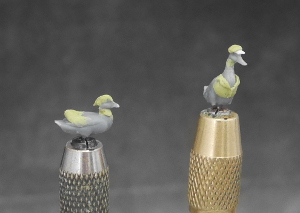
P1040301

To the left is a WIP mandarin duck, which mostly needs sharpening up in a few places, while on the right is the leader of the Glorious Duck Revolution, Lenin the Mallard. There will be plenty more ducks over the coming year or so.

Anyway, back to France. The actual shop frontage is almost finished now and I’ve started working on some extra details.
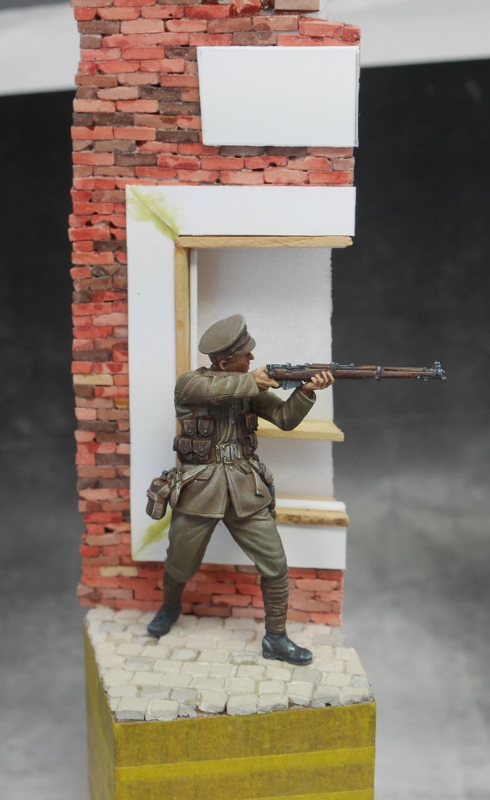
P1040303

It’s still a little rough in places, but it’s coming together. The right hand side has also been sanded flat, and the back is… getting there. It’s slow, dull work, but if I force it I know I’ll just end up breaking something and then I’ll be really pissed with myself.

Speaking of piss: I dug up some resin wine bottles I had lying around (I honestly have no idea where or when I got these, I just knew they were in one of my many crates) and painted them up for the shop display.

P1040302

I’m pretty pleased with how they’ve come out, if I’m honest. I should try to figure out where they came from and get a few more for some future projects.

Finally, I have finally taken (huge) finished pictures of the Occitan knight to put up on Putty and Paint – throw a vote my way if you’re so inclined.
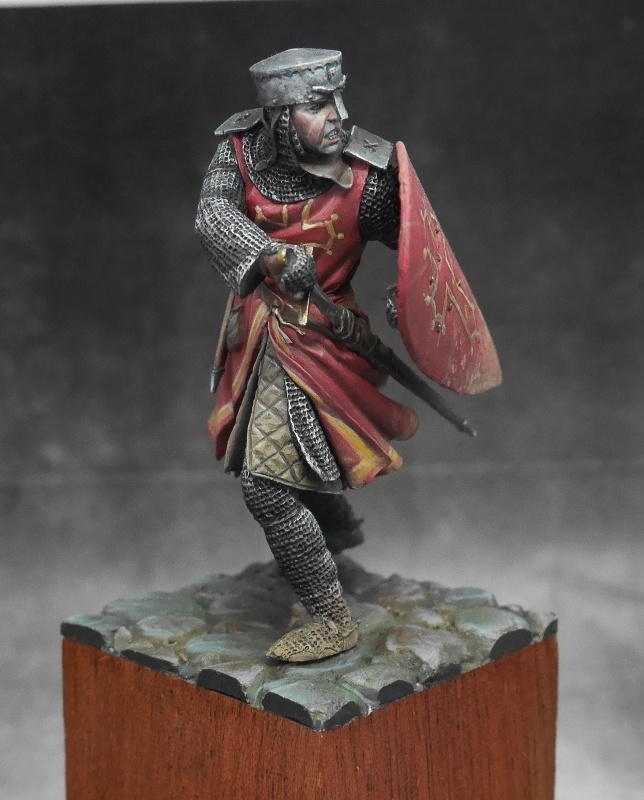
Perhaps bricklaying is more my forte

The WWI chap continues apace – in fact, he’s nearly done. As you’ll see below, getting most of the details done has really brought the uniform together. Only his rifle to finish and his boots to paint, then I can weather him appropriately.

His base, however, is merely beginning to take shape.

As I mentioned last time, I ordered a bunch of bricks to check out (they’re not terribly expensive – most places seem to charge £6 to £8 for anywhere from 500-1,000 of them. One of the sets I got was clearly designed for making large structures: the bricks are all uniform sizes and very, very crisp. The other set is more detailed, so the bricks are good for rubble – there are three types of brick in the set, depending on what sort of bricks you want to represent.

While I could have used the really uniform bricks for this work, I went with the more detailed ones simply because they’re slightly less uniform, which would make (I hope) for a more interesting wall. It’ll be slightly less than perfect, and any really large open surfaces will be prone to looking poorly built, but that hopefully won’t be too much of an issue in this case, as there’s going to be a fair bit of extra detail to cover those areas.

Anyway, so far I’ve built the section below the window and started going up the side:

It’s quite a relaxing thing to do, I must say. I can see the appeal in bricklaying, and I know for a fact that Winston Churchill was also a fan.

One problem I will have is how to smooth off the sides and back of the building. I’ve deliberately built out over the edge so I can work it back and flatten it off, but I foresee problems getting this to be even. I’ll probably cover those surfaces with plasticard anyway, but grinding down the edges of the bricks and cutting the foam simultaneously could be awkward, and I don’t want the building to end up lopsided or curved, as you can imagine.

I was thinking about getting a little electric palm sander, but my experiences with power tools are pretty limited. I have a nifty hedge trimmer that I enjoy using, but that’s really the extent of it. If anyone has experience in these matters, I’d really love some pointers on a) whether this will work at all, and b) which make and model would be best for my needs.

Somewhere in France

Not a huge amount of progress to report, but that’s what happens when you decide to repaint a fairly large section of a model. I’m much happier with how the jacket has come out, but it may need a few more glazes to bring the colour in (as much as that seems wrong when painting a really bland uniform).

I’ve also put in a start on a few other parts – the pouches, straps and gaiters. The pouches are mostly there; they just need some refining to make them work. Perhaps some stronger oranges in the midtones – the highlights are washing out the colour at the moment. The gaiters have the light in place, but they’re a bit glossy and could do with some attention. I’m not too bothered about making them flawless or interesting to look at, of course: they’re gaiters, not some fascinating piece of fashion.

Anyway, pictures:


I’ve also made a start on his base. As I mentioned previously, I want to put him in a street scene, which means making a paved street, at the very least. Several years ago, I conveniently bought a set of plaster cobblestones made by Plus Model, so I thought I’d crack them out to make my life easier. I was mistaken.

The cobbles I bought were basically cubes, which would mean having a fairly deep layer of plaster on the base. As we all should know, plaster isn’t very durable (and this plaster is especially crumbly) and having a pin or two going through it just means that the plaster will break and the model will wobble, eventually smashing much of the rest of the plaster around the pin and eventually coming loose. To mitigate this, I decided to trim the cobblestones down to a more reasonable depth, which means there’s now plaster dust and fragments everywhere, and it took much, much longer than it should have.

The other problem is that the cobblestones weren’t equally sized, so I had to do a little trimming now and then to make it work. A little inconsistency is a good thing – it makes it look more authentic – but it doesn’t help when you’re trying to make something that’s approximately ordered. Anyway, the footpath is now done with the exception of some more weathering to the surface – the act of levelling the stones has left it too uniform now.


The empty space will be taken up with a shopfront. I have a plan to have a little window display behind glass and perhaps some shutters, and it will obviously need to be quite tall. I may have to limit that ambition, however, as I’ll need to actually transport him. I’ve ordered a lot of plaster bricks for the walls themselves, and I’m hoping they’re a little more consistent than the cobblestones…

English uniform is a ghastly colour

It’s been a wee while since I updated the blog – I’ve been a little busy for the last few weeks, and haven’t done a lot of painting since I got back from Ingolstadt. I did head down to London for the British Model Soldier Society’s annual show, where I picked up a bunch of very nice medal (three golds, two silvers and a bronze). As I explain to people, the BMSS seems more interested in history than in painting, so the bar wasn’t set as high as it might be at other, larger shows. Regardless, it was very nice to get the medals (and they really are very, very nice – probably among the nicest I have from any show).

Since then, all I’ve really put a brush to is a WWI private of the Lincolnshire Regiment by Tommy’s War. I’ve painted a few pieces from the range in the past, but I’d steered away from WWI over time because of the uniforms – British uniforms in the Great War were a really, really ugly colour. Pick up a bottle of VMC English Uniform and have a look.

On the plus side, the dyes they used were pretty cheap and the uniforms were mass-produced by a range of different manufacturers, so there’s a bit of variety in the actual colours, especially after a few weeks in the trenches. As such, I thought I’d try to make my own uniform colour, which has sort of worked and sort of not:

The trousers I’m pretty happy with – they have the sort of finish I’m after and the hint of green is what I wanted. The jacket, however, has turned blue-grey somehow. I used the same colours for the mix, but apparently a very slight difference in the ratios has resulted in quite a different colour.

I’ll need to rework that quite a bit to make it fit – I’ll probably shift it more towards brown than the trousers and then glaze the green in at the end.

You’ll also note that the unpainted parts have been washed with brown, which I don’t normally do. For Tommy’s War figures, however, it’s pretty essential. They all have a lot of straps, pouches and other accoutrements, which means that it’s very easy to miss undercoating certain areas – especially recesses that can be hard to get shading into later. The wash lets me confirm that all those areas have been hit, and also helps to spot mouldlines I might have missed and get to know the model a little better.

Unlike a lot of other WWI figures, I fancy putting this one in an urban setting – the Tommy’s War page conveniently mentions that the regiment was involved in a withdrawal action that required them to fight street-by-street.

Herzog von Bayern 2018

I’m now back from Bavaria with probably too many pictures and a stomach full of wurst. (I love wurst. This is a Good Thing.)

The show was, much like last year, a real blast. I recommend it to all my painter friends now because it’s small enough to still have a great feel of community, while still being big enough that it doesn’t feel like you’re just invading some local show. It’s also in Ingolstadt, which is a really lovely city.

In the end, I came away with bronzes in both fantasy masters and historical masters, so I was very, very pleased. I had wurst to celebrate.

A few notes on the show:

  1. Talk of the town was obviously Kirill’s absolutely incredible NMM. As plenty of people observed, it doesn’t really work in the hand – even less so than ‘normal’ NMM does. However, the finish is utterly flawless, and I cannot even begin to comprehend how you think about putting the paint down to achieve the effect. If you have the chance to see them in person, you’ll no doubt see people holding their phone up to compare ‘in the flesh’ to camera image, and it’s really remarkable.
  2. It was, to be fair, quite quiet at the show this year. I’d say there were about a third fewer pieces there, but that’s to be expected with three other reasonably major shows on the same weekend, and a flurry of other shows and events in the coming weeks. The quality on display wasn’t really effected, however, which shows how much love there is for it. With a bit of luck, it’ll be on its own weekend next year. I’ll be there. Buy me a beer. Or wurst.
  3. I have seen comments online that historical was vastly outnumbered by fantasy, which is true, but many of the people making this comment were clearly annoyed that fantasy was ‘taking over’ and had decided not to come for that reason. It really shouldn’t need to be explained that they are very clearly part of the reason historical was so outnumbered. Seriously: if you’re worried that the love for historical pieces is dying out, the better solution is to turn up and show off what historical can be. I love both fantasy and historical for very different reasons, and I’m still perplexed that some people can be so incredibly tribal about it. Then again, I don’t count rivets, so maybe my opinion is invalid or something.
  4. Wurst.

A note on the pictures:

  1. I tried to get a picture of every single entry. I don’t think I actually managed to do this, because some stuff turned up quite late and I never realised it had appeared, some stuff was always cluttered with people, making it hard to get in there, and some entries I may have just not seen. Still, I think everyone deserves to have someone take a picture of their work – you enter pieces because you’re proud of them, and it’s nice to see that someone else has, at the very least, noticed you. Also, we can all see pictures of all the winners online – everyone takes pictures of them, many of them are on Putty and Paint, and inevitably we all talk about the really impressive stuff (*cough* Kirill *cough*).

If I somehow missed out on getting a shot of your piece, my apologies. Anyway, here they all are, very deliberately in a random order: